ARO META: THE THREE WHITE-CLAD CHIEFS WHO WELCOME LAGOS
Three sculpted figures have become a symbol of Lagos. Who are they really? Why are there three chiefs? And what story about Yoruba tradition did their sculptor seek to tell?
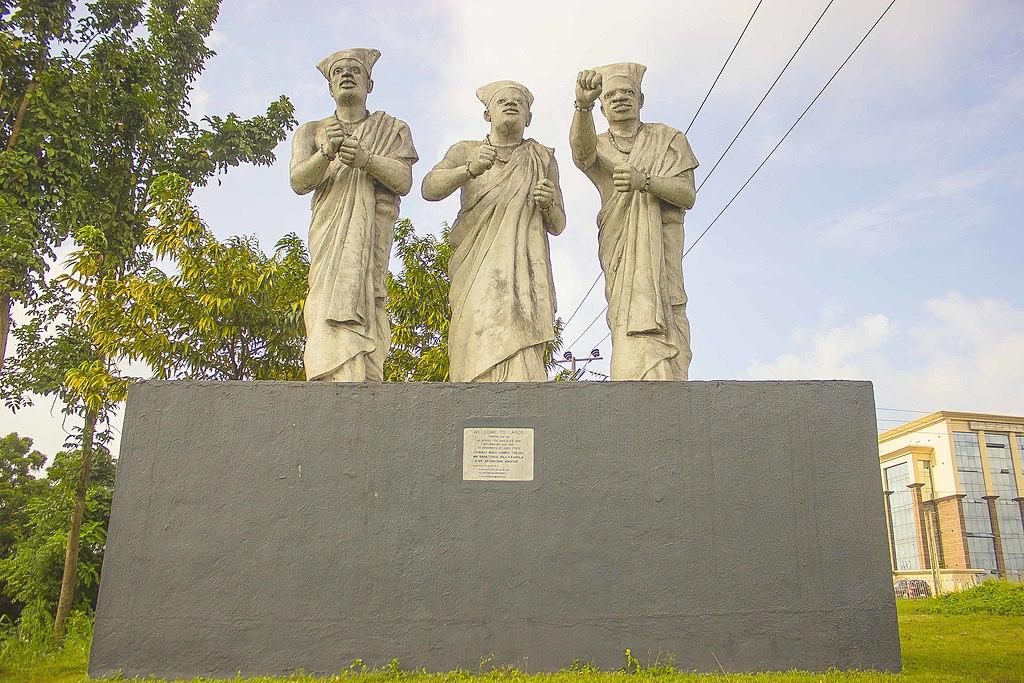
Lagos — Lagos, Nigeria - At the entrance to Lagos, Nigeria, three men appear to be waiting for visitors. Standing tall, dressed in white, wearing traditional caps and extending their fists slightly forward, they present a striking sight amid the constant movement of the city. They do not speak, move or leave their positions. Yet, since their installation in 1991, they have become one of the most recognisable symbols of Lagos. Their name is Àrò Mẹ́ta, a Yoruba expression commonly translated as “The Three Chiefs.” Also known as the “Three Wise Men” or the “Three White-Capped Chiefs,” these sculpted figures symbolically welcome those entering Lagos. But behind this familiar image lies a story far more complex than that of an ordinary welcome monument.
Who are these three men? Do they represent identifiable historical personalities, or do they embody a traditional institution? And why did their sculptor choose to portray them through three different gestures?
A sculpture created to welcome an entire city Created in 1991 by Nigerian sculptor Bodun Shodeinde, also referred to in some publications as Biodun Sodehinde, the artwork carries a clear message: welcome. Its creation took place during the military governorship of Raji Rasaki in Lagos State, when the city sought a monument capable of symbolically marking its entrance. Lagos is no ordinary city. A commercial, port and cultural metropolis, it has long attracted people from different parts of Nigeria and beyond. It is a place of encounters, migration, ambition and constant transformation. In this context, the choice of three traditional chiefs is far from insignificant. Rather than depicting an administrative building or a contemporary political figure, the artist turned to the cultural references of ancient Eko, the Yoruba name for Lagos.
He chose to give the city a face rooted in its history. The three figures are dressed in ceremonial white garments, with traditional caps and fabrics draped over their shoulders. Their imposing stature and arrangement give the composition a solemn presence. The monument does more than say, “You have arrived in Lagos.” It seems to declare: “You are entering a land with its own history, authorities and traditions.” Who are the three chiefs really? One of the most intriguing questions raised by Àrò Mẹ́ta concerns the identity of the figures. Contrary to what their appearance might suggest, they are not necessarily three historical individuals whose names have been preserved. Academic research on the sculpture associates them with the Idejo chiefs, a category of traditional dignitaries in Lagos. The Idejo occupy a distinctive position in the political and landholding history of ancient Eko. They are traditionally associated with families that hold ancestral land and with customary authorities involved in the organisation of the territory. Their representation in public space reminds us that Lagos was not shaped solely by economic and administrative development. Before becoming a major modern metropolis, it was a community organised around lineages, chieftaincies and traditional institutions.
This dimension is essential to understanding the artwork. The three sculptures are therefore more than decorative figures. They evoke a collective memory and make visible an important part of Lagos's traditional social organisation. There are, however, several popular interpretations of their identity. Some accounts associate them with different categories of traditional chiefs, including the Idejo, Akarigbere and Abagbon. These interpretations should not be confused with a historically verified identification of each individual figure. Three gestures, one shared tradition Perhaps the most fascinating feature of the artwork lies in the positions of the hands. At first glance, the three men simply appear to extend their fists forward. Yet their gestures are slightly different. The figure on the right extends his fist outward. The central figure also extends his right fist, but at a slightly downward angle. The third brings both fists together in front of him, adopting a distinct posture.
These variations are not merely aesthetic details. An academic study entitled Thematic and Stylistic Appraisal of Sculpture in Public Places in Nigeria: The Example of Southwest explains that the three figures evoke different traditional forms of greeting in ancient Eko. These are gestures of respect and recognition associated with ceremonial greetings reserved for people of high social standing. From this perspective, the artist is not simply depicting three men standing in a row before a city. He is presenting a cultural language. The body becomes a means of communication. The hand, the fist, the angle and the posture convey social codes that visitors unfamiliar with Yoruba traditions may not immediately understand. This is precisely what gives the artwork its richness: it welcomes outsiders while reminding residents of the depth of their own cultural heritage.
Bodun Shodeinde: the artist behind the three figures Behind Àrò Mẹ́ta is Bodun Shodeinde, a Nigerian sculptor whose work is associated with the representation of cultural heritage in public spaces. With this creation, he was not simply seeking to produce a monumental sculpture. He transformed a traditional greeting into an image designed to be seen, recognised and remembered by thousands of people. The use of fibreglass, mentioned in academic studies of the original artwork, made it possible to create imposing figures while reproducing anatomical and clothing details.\\ 'L;K\'`````` M The figures stand out through their powerful build, garments and traditional caps. Their white appearance enhances their visibility and ceremonial character. The artwork thus brings contemporary sculpture into dialogue with Yoruba traditional references. Its artistic message rests on a powerful idea: a city can welcome the world without abandoning the cultural foundations of its identity.
A monument confronted by beliefs and controversy The story of Àrò Mẹ́ta did not end with its installation. Initially placed near the former tollgate on the Lagos-Ibadan Expressway, the monument has experienced several relocations and difficult episodes. 9Over the years, rumours and popular beliefs linked its presence to road accidents along the highway. Some residents even attributed a negative influence to the monument in relation to events occurring in the surrounding area. These interpretations, which belong to popular belief rather than established fact, contributed to controversy surrounding the sculpture.
In 2004, the monument was set on fire. The circumstances of the incident have been reported in several accounts of its history. Authorities subsequently undertook its rehabilitation and relocation. The artwork therefore went through a period in which its symbolic function as a welcoming monument was challenged by conflicting interpretations.
This paradox reveals the complex relationship societies have with their monuments. An artwork designed to represent hospitality can become, in the popular imagination, an object of fear, suspicion and controversy. Yet Àrò Mẹ́ta has retained an important place in the visual memory of Lagos. Its image continues to circulate through photographs, urban narratives and representations of the city.
Three chiefs, one city, one memory Today, Àrò Mẹ́ta has moved far beyond its original function as a welcome monument. These three figures remind us that a city's identity is defined neither by its skyscrapers, roads nor commercial activities alone. It is also shaped by gestures, traditions, symbols and stories passed down through generations. Lagos is a city in constant transformation. Its neighbourhoods evolve, its population changes and its urban landscape shifts with its expansion. Amid these transformations, the three white-clad chiefs remain a visible representation of an older memory. They raise an essential question: how can a modern metropolis preserve the symbols of its cultural heritage while remaining open to the world?
Bodun Shodeinde offered an artistic response to this question by choosing three traditional figures rather than an anonymous symbol of modernity. Through their postures, the three men tell a story of respect, dignity and belonging. They remind us that hospitality is also an expression of culture.
Àrò Mẹ́ta is therefore more than a monument encountered while travelling through Lagos. It is an invitation to look at the city differently, to question its origins and to recognise the presence of its heritage within its contemporary landscape. Three men dressed in white. Three silent gestures. And behind them, an entire history that continues to greet those who arrive.