Tassili n'Ajjer: the Saharan plateau whose rock paintings remember a green desert
In south-eastern Algeria, a 72,000-sq-km 'plateau of rivers' holds one of the world's great collections of prehistoric art, showing cattle herders where there is now sand.
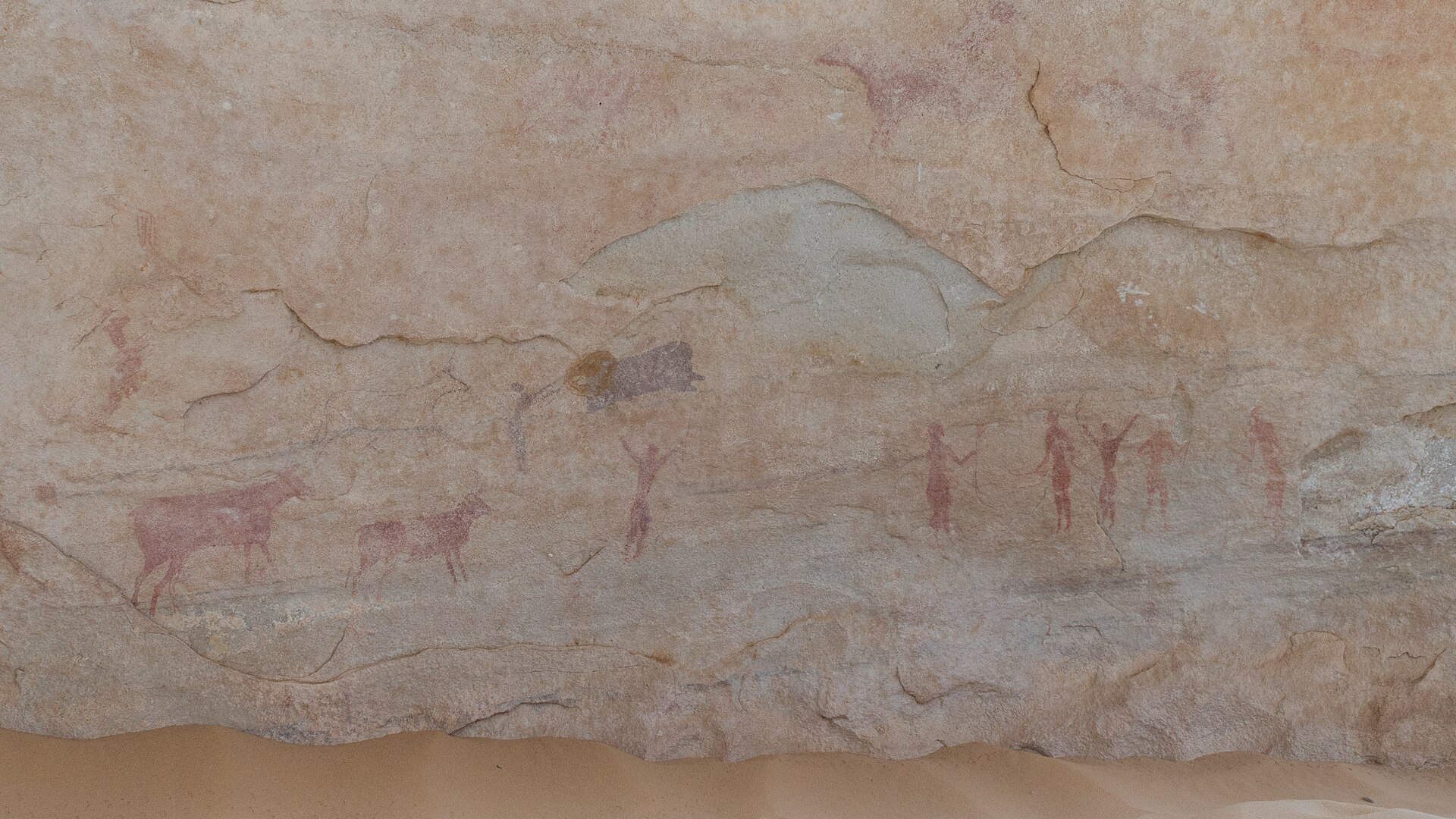
Djanet — Tassili n'Ajjer, in the Sahara of south-eastern Algeria near the borders with Libya and Niger, is one of the most important places for prehistoric rock art anywhere in the world. Its name means "plateau of rivers", and its paintings and engravings record a time when the Sahara was green.
A stone forest
The plateau covers more than 72,000 square kilometres, with its highest point, Adrar Afao, at 2,158 metres. Its sandstone, stained red and black by desert varnish, has been carved by wind and water into "rock forests", deep gorges and nearly 300 natural arches, a landscape often compared to the surface of the moon. The nearest towns are Djanet in the south-east and Illizi in the north.
A gallery from the green Sahara
Thousands of paintings and engravings cover the rock shelters. They show wild animals, people and, later, herds of cattle, reflecting the shift to herding after the African Humid Period, the thousands of years when rains turned much of the Sahara into grassland, lakes and rivers. Of all the animals depicted, only the Barbary sheep, or aoudad, still lives there today.
Ancient trees
The plateau's higher eastern half holds woodland of the endangered Saharan cypress, found nowhere else. The Tassili cypress is among the longest-living trees on Earth, outlived only by the bristlecone pines of the western United States.
Protected
Tassili n'Ajjer is a national park and biosphere reserve, and has been a UNESCO World Heritage Site since 1982. It is a reminder that the Sahara has not always been a desert, and that Africans recorded their world in art for thousands of years.
Background: Wikipedia.