The Ishango bone: a 20,000-year-old tally from the Congo
Found near the headwaters of the Nile in 1950, its 168 carved marks have been called the oldest mathematical tool of humankind.
Lire cet article en français →
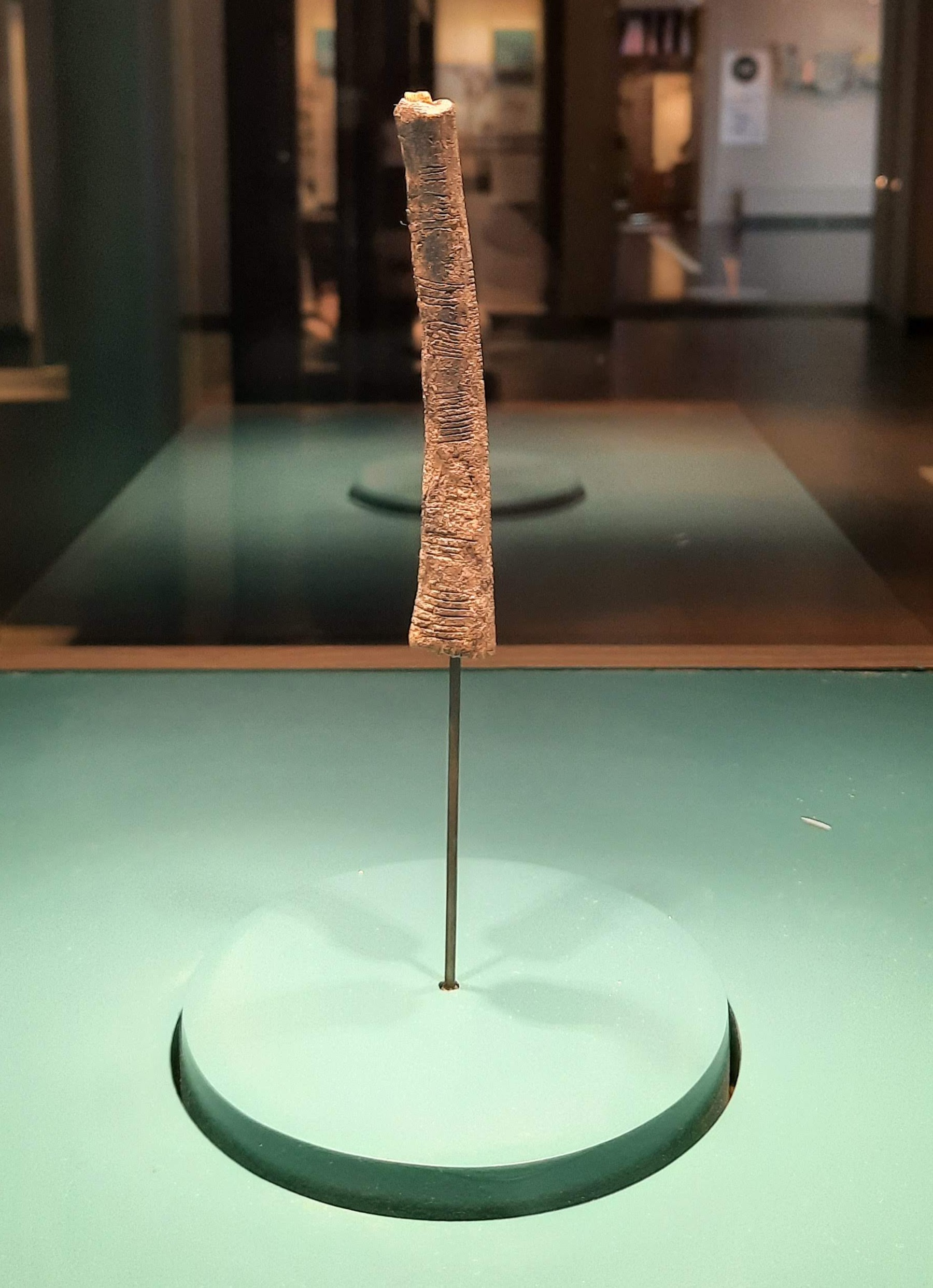
Ishango — It is about the size of a pencil: a dark brown bone with a sharp piece of quartz fixed to one end. Yet the Ishango bone, from what is now the Democratic Republic of the Congo, has made people ask how early humans began to count.
A find by the Semliki River
The Belgian Jean de Heinzelin de Braucourt found it in 1950 at Ishango, near the Semliki River, which forms part of the headwaters of the Nile. It lay among human remains and stone tools from a small community that fished and gathered food there. It is now kept at the Royal Belgian Institute of Natural Sciences in Brussels.
Early estimates put it at 8,500 to 11,000 years old. The site was later re-evaluated and the bone is now believed to be about 20,000 years old, though the date is still debated because nearby volcanic activity upset the carbon readings.
What do the marks mean?
The 168 marks run in three columns along the bone. Scholars disagree on what they were for:
- A counting tool: many think it was probably used for simple mathematical procedures, and possibly to build a numeral system.
- A calendar: another reading sees a lunar calendar.
- A better grip: some suggest the scratches had nothing to do with numbers.
It has been described as the oldest mathematical tool of humankind, although older engraved bones are known, including the roughly 42,000-year-old Lebombo bone from southern Africa. Either way, the story of careful marks and patient record-keeping runs deep in African soil.
Background: Wikipedia.