MeerKAT: the South African telescope that spotted giant bubbles at our galaxy's heart
Designed and built in South Africa, its 64 dishes in the Karoo are a stepping stone to the Square Kilometre Array.
Lire cet article en français →
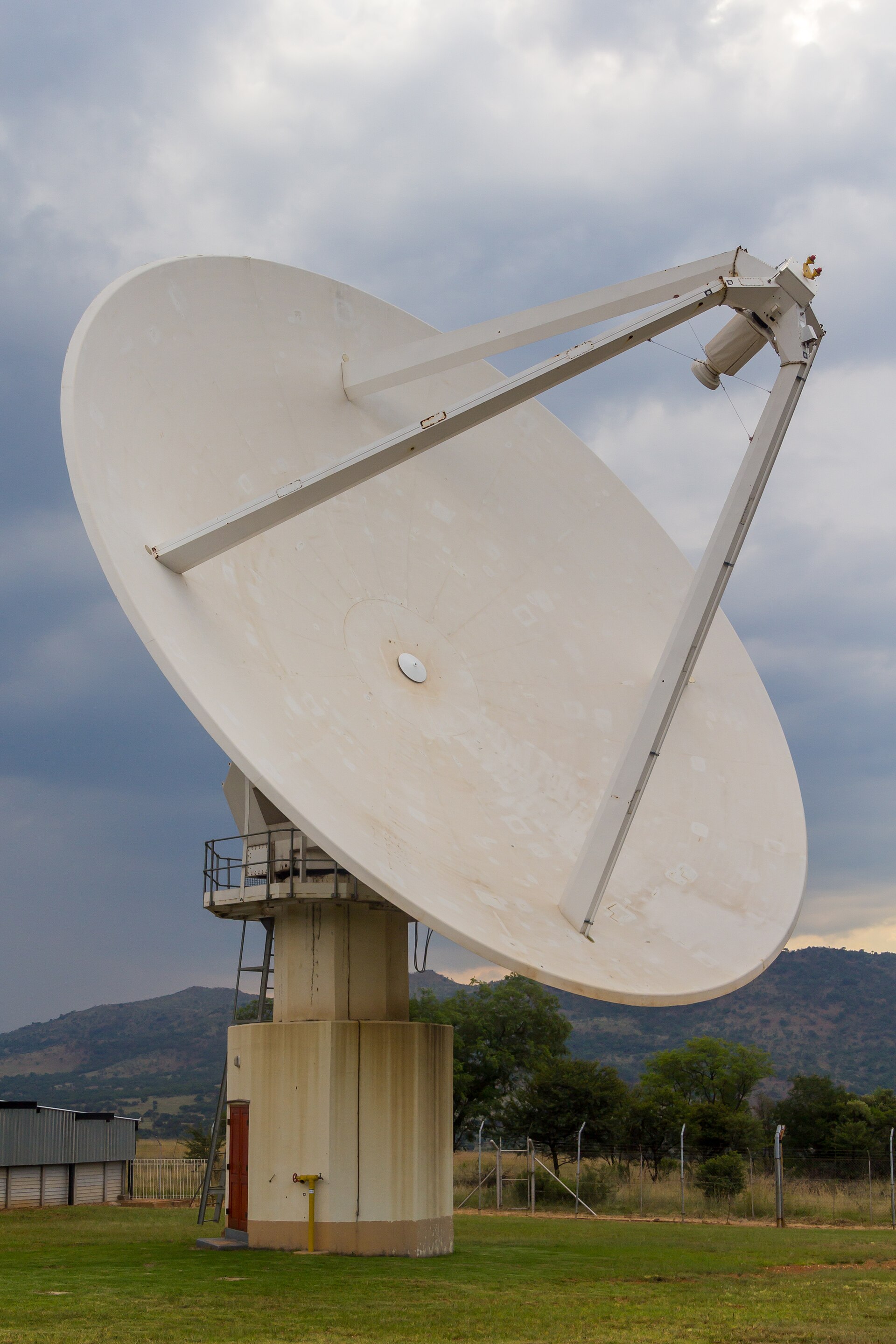
Karoo — In a protected radio quiet zone in the Northern Cape stand 64 dishes, each 13.5 metres across. They make up MeerKAT, a radio telescope designed and built in South Africa.
More of KAT
It was first planned as the Karoo Array Telescope, with 20 receptors. When the government raised the budget to allow for 64, the project took a new name, meaning "more of KAT". Construction ran from 2014 to 2018, one of the largest scientific projects in South Africa. Deputy President David Mabuza inaugurated it on 13 July 2018.
An early discovery
In September 2019, an international team using MeerKAT found enormous balloon-like structures towering hundreds of light-years above and below the centre of our galaxy. In 2023 the MeerKAT team received the Royal Astronomical Society's Group Achievement Award, citing breakthrough observations after only a short period of operation.
The road to the SKA
MeerKAT grew out of South Africa's 2003 bid to host the Square Kilometre Array, and it will be folded into SKA-Mid, a 197-dish instrument.
The experience gained has already carried over. South African engineers and industry took part in seven of the 11 SKA engineering design consortia, making up about 10% of the workforce, and the country led two of them. About 10% of the authors in the SKA Science Book are based at South African institutions.
Background: Wikipedia.