Mosi-oa-Tunya: the smoke that thunders on the Zambezi
Victoria Falls is the world's largest sheet of falling water, 1.7km wide and 108 metres high, shared by Zambia and Zimbabwe.
Lire cet article en français →
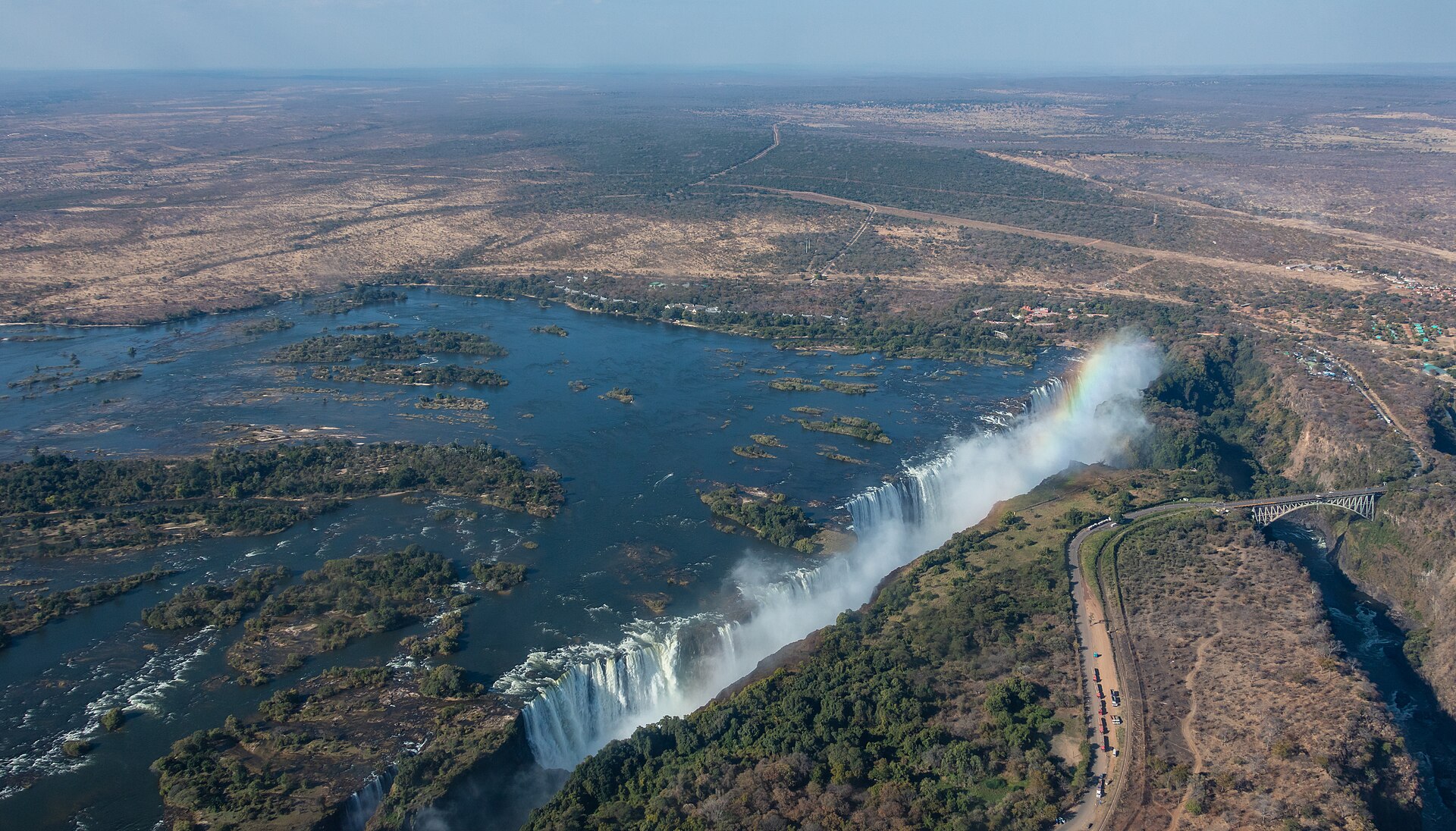
Livingstone — Long before any European saw it, the people who lived beside the Zambezi had names for the great waterfall on the river. The Lozi call it Mosi-oa-Tunya, "the smoke that thunders", after the plume of spray that can be seen from far away. The Tonga call it Shungu Namutitima, "boiling water". Older names, Seongo and Chongwe, mean "the place of the rainbow".
The largest curtain of water on Earth
Victoria Falls, on the border between Zambia and Zimbabwe, is not the tallest waterfall in the world, nor the widest. But with a width of 1,708 metres and a height of 108 metres, it forms the largest single sheet of falling water anywhere.
Upstream, the Zambezi flows across a flat sheet of basalt, dotted with tree-covered islands. At the falls the whole width of the river plunges into a narrow chasm cut into the rock.
Two names, two parks
The Scottish missionary David Livingstone was the first European recorded to see the falls, in November 1855, and named them after Queen Victoria. Both names are recognised on the UNESCO World Heritage List. Zambia's national park is called Mosi-oa-Tunya; on the Zimbabwean side, the park and town are named Victoria Falls.
The area around the falls is rich in plant and animal life, and since the mid-20th century it has been one of Africa's great tourist destinations. Scientists warn that more variable rainfall linked to climate change is likely to change the character of the falls in future.
Background: Wikipedia.