AfroTalks Youth Assembly Calls on UN for Enforceable Reparatory Justice in Nairobi
The AfroTalks Youth Assembly has called for enforceable reparatory justice for Africa following a petition initiative at United Nations offices in Nairobi on October 22, 2026, urging concrete action on restitution, compensation, debt cancellation and institutional accountability.
Nairobi, Kenya — # AfroTalks Youth Assembly Calls on UN for Enforceable Reparatory Justice in Nairobi
NAIROBI, Kenya — The AfroTalks Youth Assembly has called on the United Nations to move beyond the recognition of historical injustices toward enforceable reparatory justice for Africa and people of African descent, following a petition initiative in Nairobi on October 22, 2026.
According to a statement released by AfroTalks on October 23, representatives of the Youth Assembly brought a petition to the United Nations offices in Nairobi, calling for stronger international mechanisms to address the enduring consequences of slavery, colonialism and historical economic exploitation.
The organization said participants encountered security restrictions that limited the planned gathering. Despite these difficulties, AfroTalks reported that its representatives proceeded with their advocacy and brought the petition to the UN premises.
The materials provided to Pan-African News Media did not include an official UN acknowledgment confirming formal receipt of the petition.
From Recognition to Accountability
At the center of the initiative is a call for international institutions to translate declarations and historical acknowledgments into measurable commitments.
The petition, titled Petition for an Accountable Process for Reparatory Justice for Africa, is addressed to the United Nations Secretary-General and President of the General Assembly.
It calls for an international framework that would identify responsible institutions, establish fair procedures for claims, set implementation deadlines and provide independent oversight.
Among its principal demands are:
- Restitution: Structured processes for returning African cultural property, historical artifacts, archives and ancestral remains.
- Compensation: Accessible procedures for addressing individual and collective historical harms.
- Reparatory debt cancellation: Negotiated cancellation of eligible external public debt under transparent criteria.
- Institutional accountability: Mechanisms to assess claims, establish obligations and monitor implementation.
- Public oversight: Meaningful participation by affected communities, young people and women.
The Assembly argues that the international community must establish practical pathways for historical redress instead of relying exclusively on diplomatic discussions and nonbinding declarations.
African Youth Seeking a Greater Voice
The initiative reflects AfroTalks' wider commitment to strengthening African participation in policy discussions and international decision-making.
Bright Tenbil, Founder and Convenor of AfroTalks, emphasized the importance of accountability in a statement accompanying the petition.
"It has been very obvious that, over the years there has been no accountability," Tenbil said, criticizing the gap between international recognition of historical injustices and concrete action.
The Youth Assembly's campaign places young Africans within a broader continental conversation about sovereignty, economic independence and the long-term effects of historical exploitation.
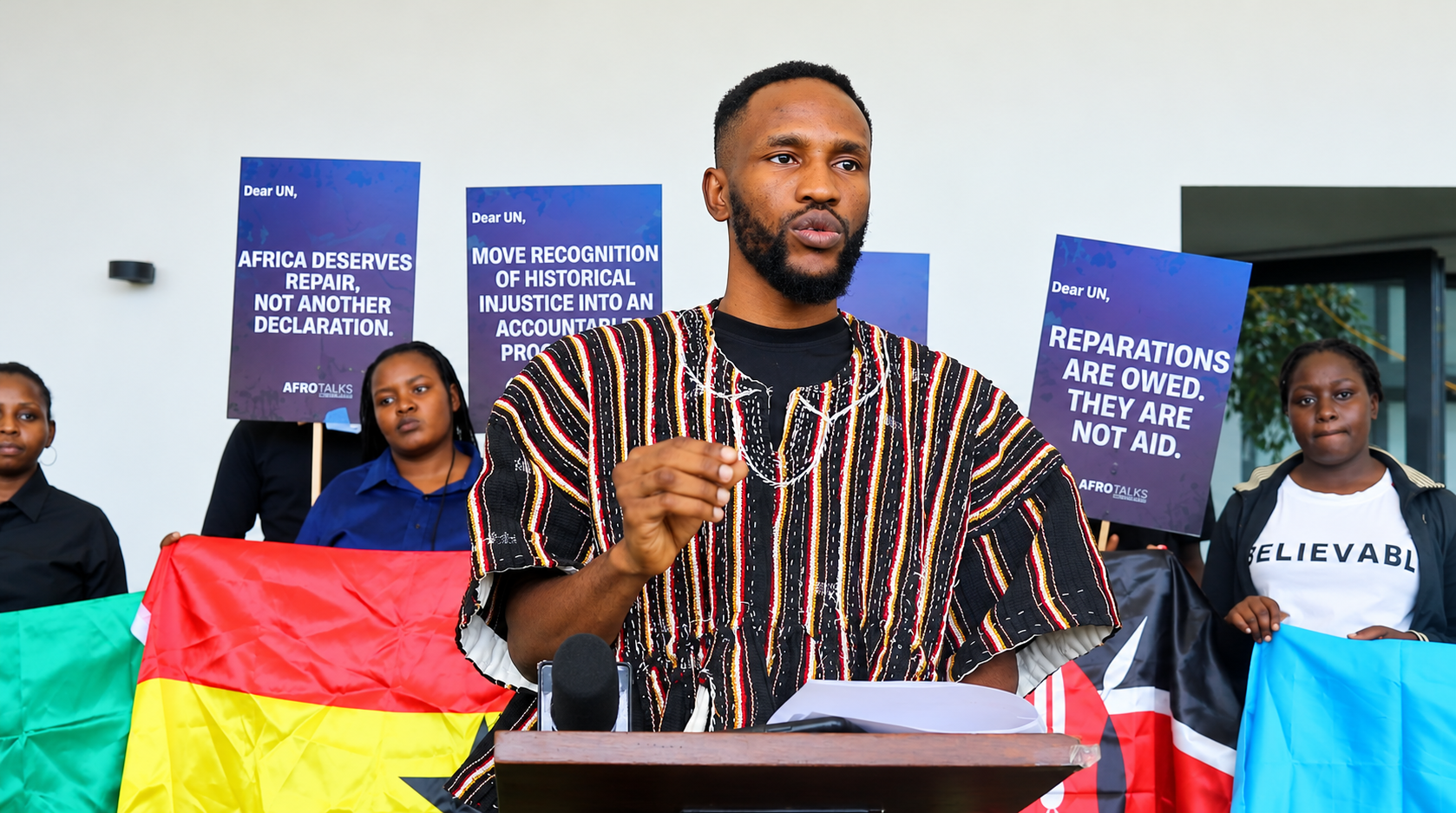
Photographs shared with PANM show participants carrying African national flags and placards addressed to the United Nations.
One placard reads: "Africa Deserves Repair, Not Another Declaration."
Another states: "Reparations Are Owed. They Are Not Aid."
These messages reflect the Assembly's demand that reparatory justice be addressed through formal commitments rather than charitable or development assistance alone.
A Proposed Framework for Action
The petition outlines a series of proposed institutional measures and implementation milestones.
It requests a UN-supported accountability mechanism coordinated with the African Union and the Caribbean Community (CARICOM), with participation from legal experts, historians and affected communities.
The Assembly proposes that such a mechanism publish its operating arrangements within six months of an implementation mandate, complete initial debt and restitution inventories within twelve months, and work toward the first negotiated agreements within twenty-four months.
These are proposals from AfroTalks, not timelines adopted by the United Nations.
The petition also acknowledges that enforceable compensation and debt cancellation would require appropriate legal authority, agreements and implementation mechanisms.
A Continuing Continental Campaign
AfroTalks says the October 22 action is intended to mark the beginning of sustained advocacy rather than the conclusion of a single demonstration.
The organization plans to pursue continued diplomatic engagement, youth mobilization and dialogue with relevant international institutions.
The initiative was also connected to AfroTalks Nairobi 2026, held under the theme Redefining African Sovereignty through Ownership, Capital and Innovation.
Through the petition, the Assembly is seeking to connect discussions on reparatory justice with broader questions of Africa's economic future, institutional influence and participation in global decision-making.
The organization has called for the United Nations to acknowledge the petition and communicate a pathway for its consideration.
It has also emphasized the importance of protecting peaceful civic participation in international institutional spaces.
The campaign is being promoted under the hashtag #UNEnforceReparatoryJusticeNow.
What Happens Next?
Questions remain about the formal status of the petition, the response of relevant UN offices and the practical pathways through which its proposals could be considered.
AfroTalks says it intends to pursue these questions through sustained advocacy and engagement with international stakeholders.
Pan-African News Media will continue following developments surrounding the initiative and the broader conversation on reparatory justice for Africa.
The full petition is available through AfroTalks' official advocacy page.
Reporting: PANM Newsroom | Pan-African News Media